
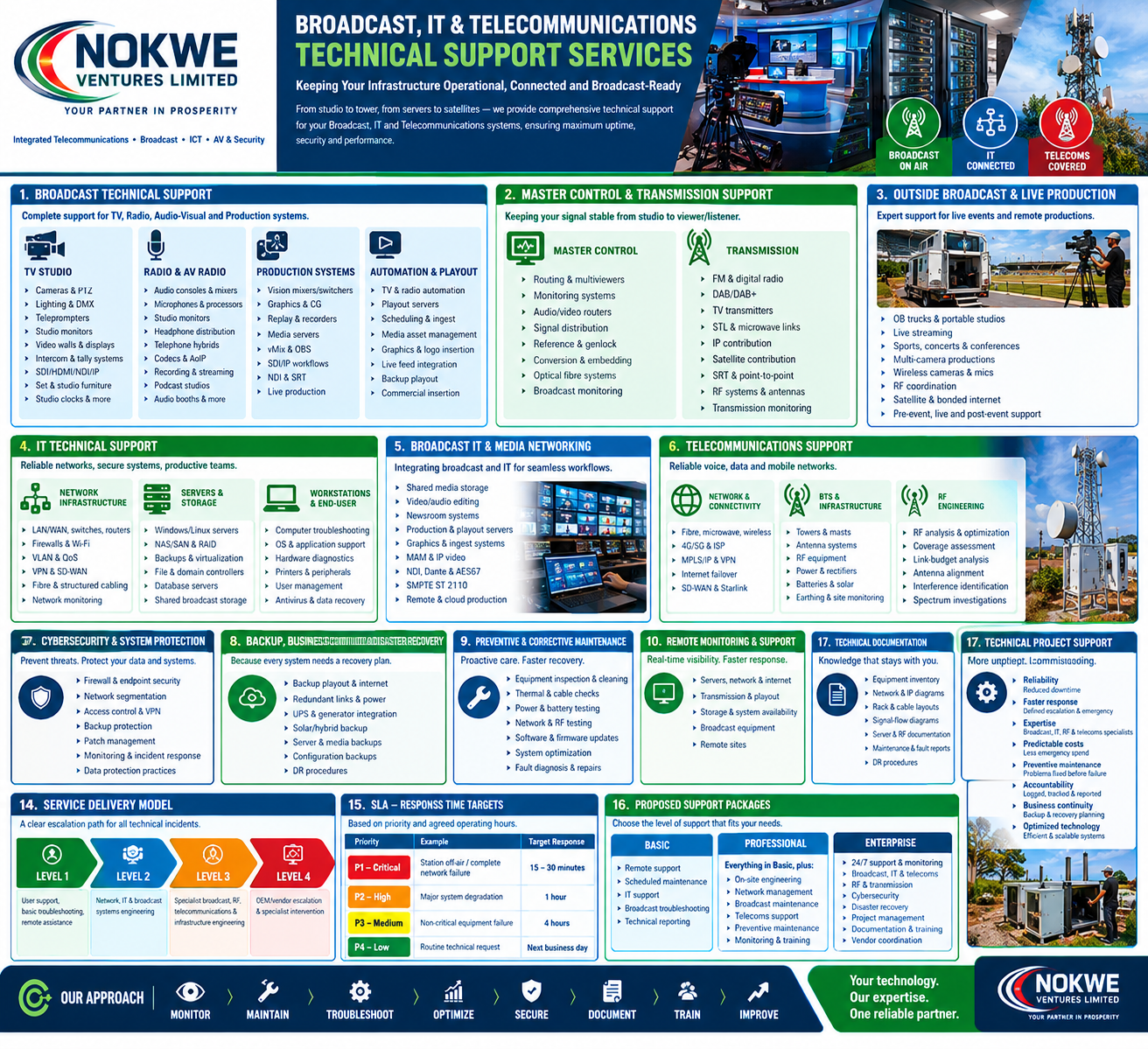
BROADCAST, IT & TELECOMMUNICATIONS TECHNICAL SUPPORT SERVICES
Keeping Your Infrastructure Operational, Connected and Broadcast-Ready
Executive Pitch
In modern broadcasting, technical downtime is not simply an IT problem—it is a business, audience and revenue problem.
A failed studio system, unstable network, transmission interruption, server failure, faulty audio chain, cybersecurity incident or telecommunications link can bring an entire operation to a standstill.
We provide comprehensive technical support and maintenance services covering Broadcast Engineering, IT Infrastructure and Telecommunications Systems, giving your organization access to a single technical support partner capable of managing the complete technology ecosystem.
Our objective is simple:
Keep your broadcast on-air, your IT systems available, your communications connected and your technical infrastructure performing reliably.
We provide both preventive and corrective maintenance, remote technical assistance, on-site engineering support, system monitoring, troubleshooting, optimization, documentation and emergency response.
1. BROADCAST TECHNICAL SUPPORT
Our broadcast engineering support covers the complete technical chain from content production to transmission and distribution.
A. TV Studio Support
We provide technical support for:
Studio cameras and PTZ cameras
Professional video cameras
Camera control systems
Studio lighting systems
LED lighting and DMX systems
Teleprompters
Studio monitors
Video walls
Interactive displays
News desks and studio sets
Intercom systems
Tally systems
Studio clocks
Floor-monitoring systems
SDI, HDMI, NDI and IP video infrastructure
Video converters and distribution systems
B. Radio & Audio-Visual Radio Support
Support includes:
Radio studio systems
Audio consoles and digital mixers
Microphones and microphone processors
Studio monitor speakers
Headphone distribution
Telephone hybrids
Codec systems
Audio processors
Digital audio routing
AoIP systems
Studio-to-studio links
Playout integration
Recording systems
Podcast studios
Streaming studios
Audio booth systems
C. Production Systems
Technical support for:
Vision mixers/switchers
Production servers
Graphics systems
Character generators
Replay systems
Media servers
Video playback systems
Recording systems
Live production systems
vMix-based production systems
OBS and streaming systems
SDI/IP workflows
NDI systems
SRT contribution systems
D. Broadcast Automation & Playout
We support:
TV automation systems
Radio automation systems
Playout servers
Scheduling systems
Media asset management
Content ingest
Playlist management
Graphics integration
Logo insertion
Live-feed integration
Backup playout systems
Disaster-recovery playout
External live-feed integration
Commercial insertion systems
2. MASTER CONTROL & TRANSMISSION SUPPORT
We provide engineering support for the systems responsible for maintaining continuous transmission.
Master Control
Support includes:
Master control systems
SDI/IP routing
Multiviewers
Monitoring systems
Video/audio routers
Signal distribution
Synchronization systems
Reference/Genlock
Audio embedding/de-embedding
Signal conversion
Optical fibre systems
Broadcast monitoring
Transmission Systems
We support:
FM transmission systems
Digital radio transmission
DAB/DAB+
TV transmitters
STL systems
Microwave links
IP contribution links
Satellite contribution
SRT links
Point-to-point transmission
Encoder/decoder systems
RF systems
Antenna systems
RF combiners
Transmission monitoring
Remote transmitter sites
3. OUTSIDE BROADCAST & LIVE PRODUCTION SUPPORT
For organizations undertaking live events, we provide support for:
OB trucks
Portable production systems
Portable studios
Live streaming systems
Sports production
Corporate events
Concerts
Conferences
Political events
Religious events
Multi-camera productions
Wireless camera systems
Wireless microphones
RF coordination
Live contribution links
SRT transmission
Bonded internet connectivity
Satellite connectivity
Our engineers can support the operation from pre-event system preparation through live production and post-event shutdown.
4. IT TECHNICAL SUPPORT
Broadcast operations increasingly depend on IT infrastructure. Our support therefore extends beyond traditional broadcast equipment.
Network Infrastructure
We support:
LAN/WAN infrastructure
Managed switches
Routers
Firewalls
Wireless networks
Enterprise Wi-Fi
VLAN configuration
Network segmentation
IP addressing
DHCP
DNS
VPN
QoS
Network monitoring
Fibre networks
Structured cabling
Network redundancy
Servers & Storage
Support includes:
Windows and Linux servers
NAS systems
SAN systems
RAID storage
Backup servers
Virtualization
File servers
Domain controllers
Database servers
Media storage
Shared broadcast storage
Network-attached production storage
Workstations & End-User Support
We provide:
Computer troubleshooting
Operating system support
Application installation
Hardware diagnostics
Printer support
User account management
Software updates
Driver management
Workstation configuration
Antivirus/endpoint protection
Data recovery assistance
5. BROADCAST IT & MEDIA NETWORKING
We specialize in the intersection between broadcast engineering and IT infrastructure.
This includes designing and supporting networks for:
Shared media storage
Video editing
Audio editing
Newsroom systems
Production servers
Playout servers
Graphics systems
Ingest systems
MAM systems
IP video
NDI
Dante
AES67
SMPTE ST 2110 environments
Remote production
Cloud-connected workflows
Our objective is to ensure that the IT network does not become a bottleneck or single point of failure for the broadcast operation.
6. TELECOMMUNICATIONS TECHNICAL SUPPORT
Our telecommunications support covers both enterprise communications and field infrastructure.
Network & Connectivity
We support:
Fibre internet
Point-to-point wireless links
Microwave links
4G/5G connectivity
ISP connectivity
MPLS/IP connectivity
VPN connectivity
Internet failover
SD-WAN
Remote-site connectivity
Starlink and satellite internet integration
BTS & Telecom Infrastructure
Support can cover:
BTS infrastructure
Telecom towers/masts
Antenna systems
Feeder cables
RF equipment
Power systems
Rectifiers
DC systems
Battery backup
Solar backup systems
Earthing systems
Site monitoring
Preventive maintenance
RF optimization
RF Engineering
Support includes:
RF signal analysis
Coverage assessment
Link-budget analysis
Antenna alignment
RF optimization
Interference identification
Spectrum-related technical investigations
Microwave link alignment
Transmission-line testing
7. CYBERSECURITY & SYSTEM PROTECTION
Technical support must also protect the infrastructure against cyber threats.
We provide support for:
Firewall configuration
Endpoint security
Antivirus/EDR
Network segmentation
User access control
Password policies
VPN security
Backup protection
Server hardening
Patch management
Security monitoring
Incident response support
Data protection practices
We also assist in identifying technical vulnerabilities before they become operational failures.
8. BACKUP, BUSINESS CONTINUITY & DISASTER RECOVERY
Broadcast operations require continuity.
We help establish:
Primary System → Backup System → Disaster Recovery
This can include:
Backup playout
Backup internet
Redundant transmission links
Backup power
UPS systems
Generator integration
Solar/hybrid backup
Server backups
Media backups
Configuration backups
Disaster recovery procedures
Emergency transmission procedures
Our philosophy is:
Every critical system should have a recovery plan.
9. PREVENTIVE MAINTENANCE
Rather than waiting for equipment to fail, we implement scheduled maintenance programs.
Preventive maintenance may include:
Equipment inspection
Cleaning
Thermal inspection
Cable inspection
Connector inspection
Power-supply testing
UPS testing
Battery testing
Network performance testing
RF testing
Audio testing
Video signal testing
Server health checks
Storage health checks
Software updates
Firmware updates
Configuration backups
System optimization
A preventive maintenance report can be provided after every scheduled visit.
10. CORRECTIVE & EMERGENCY TECHNICAL SUPPORT
When something fails, response time matters.
Our corrective support covers:
Broadcast outages
Audio failures
Video failures
Network failures
Server failures
Playout failures
Transmission failures
RF problems
Internet outages
Studio equipment failures
Software failures
Configuration problems
Power-related technical faults
Depending on the agreed SLA, support can be provided through:
Remote Support → Telephone Support → On-Site Engineering → Emergency Intervention
11. REMOTE MONITORING & TECHNICAL SUPPORT
Where technically possible, we can establish remote monitoring and support for critical infrastructure.
This enables engineers to monitor:
Servers
Network devices
Internet connectivity
Transmission systems
Playout systems
Storage
System availability
Selected broadcast equipment
Remote sites
Remote support can significantly reduce response time and unnecessary site visits.
12. TECHNICAL DOCUMENTATION
A major weakness in many technical operations is inadequate documentation.
We can establish and maintain:
Equipment inventory
Asset registers
Network diagrams
IP address schedules
Rack layouts
Cable schedules
Broadcast signal-flow diagrams
System configurations
Server documentation
RF documentation
Site documentation
Maintenance records
Fault reports
Incident reports
Backup procedures
Disaster-recovery procedures
This ensures that the technical knowledge of the organization does not depend on one individual engineer.
13. TECHNICAL TRAINING & STAFF CAPACITY BUILDING
We can provide practical training for your technical and operational teams in:
Broadcast equipment operation
Studio systems
Audio systems
Video systems
Vision mixing
Playout systems
Broadcast automation
Network management
SRT/streaming technology
IT troubleshooting
RF systems
Preventive maintenance
Emergency fault response
Basic cybersecurity
System documentation
The goal is to build an internal team capable of identifying and resolving first-level technical problems.
14. TECHNICAL PROJECT SUPPORT
Beyond maintenance, we can provide engineering support for new projects and upgrades.
This includes:
Technical requirements development
Equipment specification
System design
Vendor evaluation
Bill of quantities
Procurement support
Equipment installation
System configuration
Integration
Testing
Commissioning
Staff training
Documentation
Project handover
This allows the client to work with one technical partner from concept → design → procurement → installation → commissioning → maintenance.
15. SERVICE DELIVERY MODEL
We recommend a structured support model comprising four levels:
| Level | Support |
|---|---|
| Level 1 | User support, basic troubleshooting and remote assistance |
| Level 2 | Network, IT, broadcast and systems engineering |
| Level 3 | Specialist broadcast, RF, telecommunications and infrastructure engineering |
| Level 4 | OEM/vendor escalation and specialist equipment intervention |
This creates a clear escalation path for technical incidents.
16. SERVICE LEVEL AGREEMENT — SLA
Our support agreement can be structured around agreed response times.
For example:
| Priority | Example | Target Response |
|---|---|---|
| P1 – Critical | Station off-air / complete network failure | 15–30 minutes |
| P2 – High | Major system degradation | 1 hour |
| P3 – Medium | Non-critical equipment failure | 4 hours |
| P4 – Low | Routine technical request | Next business day |
Final response and resolution targets would be agreed according to the client’s operating hours, location and SLA package.
17. WHAT THE CLIENT GAINS
By outsourcing technical support to a specialized engineering partner, the client gains:
Reliability
Reduced equipment and system downtime.
Faster Response
A defined technical escalation and emergency response mechanism.
Expertise
Access to broadcast, IT, RF and telecommunications specialists.
Predictable Costs
Reduced dependence on expensive emergency interventions.
Preventive Maintenance
Problems are identified before they become failures.
Accountability
Technical incidents are logged, tracked and reported.
Business Continuity
Critical systems receive appropriate backup and recovery planning.
Technology Optimization
Existing infrastructure is continuously reviewed and optimized.
18. OUR VALUE PROPOSITION
We do not see technical support as simply “fixing equipment when it breaks.”
Our approach is to become an extension of your technical department.
We provide:
MONITOR → MAINTAIN → TROUBLESHOOT → OPTIMIZE → SECURE → DOCUMENT → TRAIN → IMPROVE
This creates a proactive technical environment in which your broadcast, IT and telecommunications infrastructure remains available, secure, scalable and fit for purpose.
19. PROPOSED SUPPORT PACKAGE
We can structure the engagement around three service categories:
BASIC
Remote technical support
Scheduled maintenance
IT support
Broadcast troubleshooting
Technical reporting
PROFESSIONAL
Everything in BASIC, plus:
Regular on-site engineering
Network management
Broadcast system maintenance
Telecommunications support
Preventive maintenance
System monitoring
Staff training
ENTERPRISE / MANAGED TECHNICAL SERVICES
A comprehensive technical partnership covering:
24/7 technical support
Remote monitoring
Broadcast engineering
IT infrastructure
Telecommunications
RF systems
Transmission
Cybersecurity
Preventive maintenance
Emergency response
Disaster recovery
Technical project management
Documentation
Staff training
Vendor/OEM coordination
OUR COMMITMENT
Your technology infrastructure should work for your organization—not against it.
Our technical support model is designed to ensure that your studios, broadcast systems, transmission infrastructure, IT networks and telecommunications systems remain operational and professionally maintained.
We keep you:
ON AIR.
CONNECTED.
SECURE.
SUPPORTED.
READY.
We would welcome the opportunity to conduct a technical infrastructure assessment of your facilities and develop a customized support plan, including the recommended SLA, maintenance schedule, response times and technical support coverage.
Your technology. Our expertise. One reliable technical support partner.